
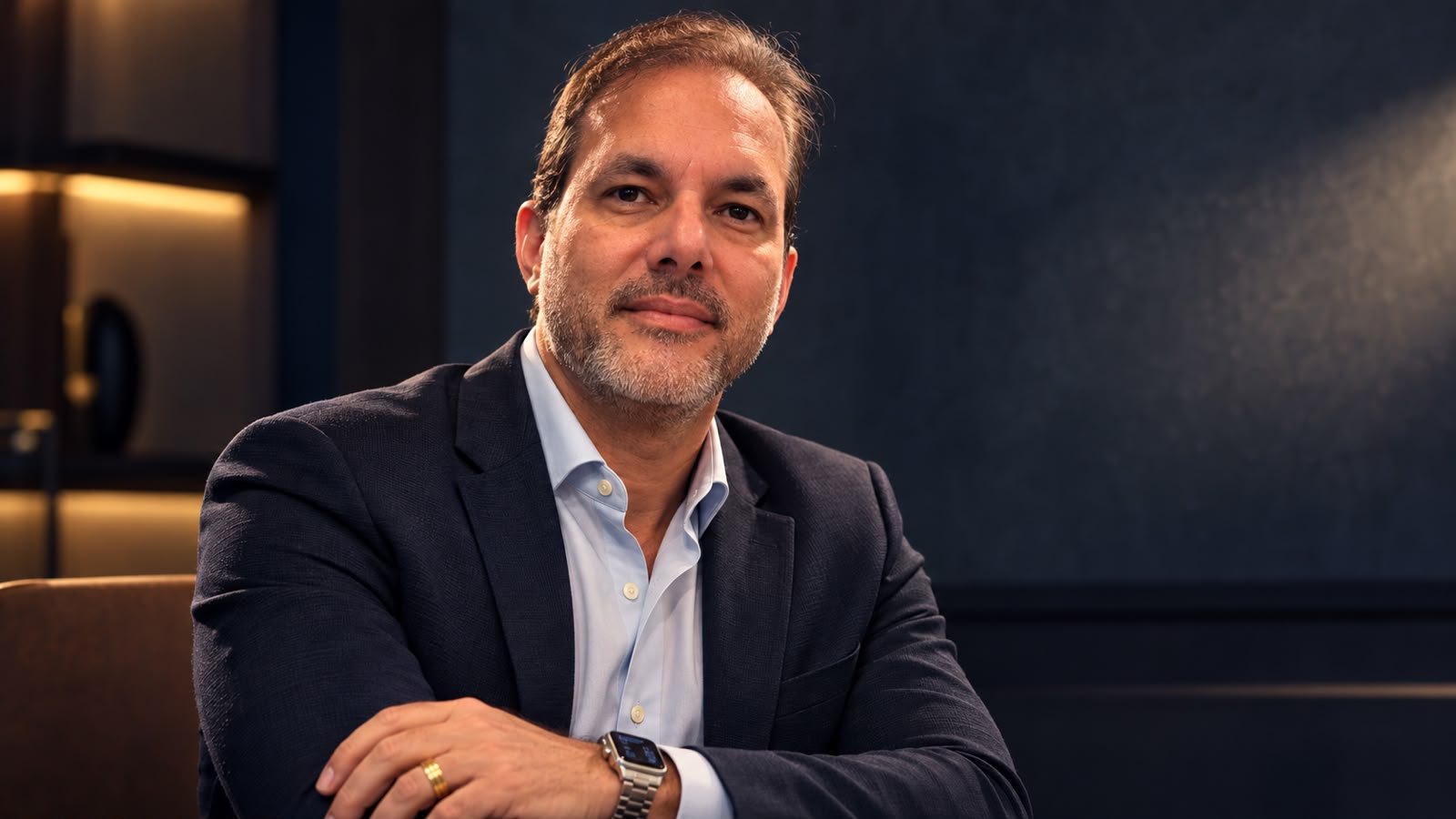
A Brazilian veterinarian, researcher and author, Marcelo Müller has built a career spanning science, public health, vaccines, biotechnology, clinical practice, surgery, animal welfare and science communication. Today, he brings these experiences together through a vision that connects One Health, sentience, innovation and public policy
Few careers span laboratory research, vaccine development, public health operations, research in the animal health industry, surgery and the home of a family caring for a sick dog or cat. Marcelo Müller’s career has taken him through all of these settings.
A veterinarian with a master’s degree in Clinical Research from the National Institute of Infectious Diseases at the Oswaldo Cruz Foundation (Fiocruz), Müller has built a career that brings together science, public health, biotechnology, management, small-animal clinical practice and surgery, animal welfare and science communication.
These fields have always been closely connected in his work. Even during periods of greater involvement in research, laboratory management and technological development, he continued to practise clinical medicine and surgery.
Working across these different settings has shaped the perspective that guides him today: scientific advances must translate into practical benefits for individuals and society.
A career that began in research
From there, his work gradually expanded into new areas and responsibilities.
Before taking on laboratory management roles, he became biosafety coordinator at Bio-Manguinhos. He later worked in the Immunological Technology Laboratory, where he was involved in clinical research, immunology, vaccines and biopharmaceuticals.
He subsequently became manager of viral vaccines, contributing to projects involving yellow fever, measles and rubella, among other diseases.
During the COVID-19 pandemic, he managed Bio-Manguinhos/Fiocruz’s COVID-19 Diagnostic Support Unit, which processed RT-PCR tests to meet the needs of Brazil’s Unified Health System, known as SUS.
These roles brought research, biosafety, technological development, management and public health together within one career.
His scientific work developed alongside these responsibilities, with studies in immunology, vaccines, clinical research, biopharmaceuticals, biosafety and animal experimentation, as well as participation in national and international scientific conferences.
From Public Health to Innovation in Industry
Müller also brought his experience at Fiocruz to the animal health industry, where he worked in research and development management, focusing on biotechnology, bacterial, viral and recombinant vaccines, biopharmaceuticals, pharmaceutical formulation development and technology transfer.
Moving between a public institution, industry and clinical practice broadened his understanding of the role of veterinary medicine itself.
Developing a vaccine, building a diagnostic system, operating on a patient or caring for an animal in its own home are very different activities. For Müller, however, they all begin with the same principle: turning knowledge into practical results.
Clinical practice throughout his career
His clinical work with dogs and cats did not begin after his work in science and management. It developed alongside them.
While working in research, vaccine development, public health and innovation, Müller continued treating patients and performing surgery. That continuity matters because his career cannot simply be divided into a scientific phase followed by a clinical one. The two developed together.
In clinical practice, particularly in the home environment, observation goes beyond test results to include the way an animal actually lives. How it moves. How it sleeps. How it interacts. Whether it seeks out its family. Whether it shows fear, interest or discomfort. Whether it can still engage in its usual behaviours and activities.
“A test can tell us a great deal about a disease, but it does not necessarily tell us everything about how that individual is living,” Müller says.
This broader view of the patient has made animal welfare and sentience increasingly central to his professional work.
One Health as a common thread
Although One Health has gained greater international visibility in recent years, its underlying principles have been present throughout different stages of Müller’s career. His experience with infectious diseases, biosafety, immunology, vaccines, public health diagnostics and veterinary medicine repeatedly placed his work at the interface between human and animal health.
More recently, that integration has expanded more explicitly to include the environment, prevention, zoonotic diseases and public policy.
For Müller, One Health should not remain merely an academic concept. It becomes practical when veterinarians contribute to zoonotic disease prevention, surveillance, vector control, public education, research, environmental health and the development of policies that recognize that animals, people and the environment share both risks and solutions.
This perspective also appears in his recent scientific work, including studies on in-home veterinary care, animal welfare, heartworm disease and One Health.
For him, the contemporary role of the veterinarian extends far beyond treating disease. It also includes prevention, population health and participation in decisions that can affect entire communities.
Animal welfare and sentience
This integrated perspective has also changed the questions asked about the individual patient.
In recent years, Müller has frequently addressed pain, longevity, ageing, behaviour, mental health, rehabilitation, prevention, multispecies families, the human-animal relationship and quality of life. Sentience is an important part of that discussion.
Recognizing that animals have subjective experiences, including pain, fear, anxiety, comfort, a sense of safety and pleasure, means acknowledging that veterinary decisions have consequences that extend beyond laboratory results. The question is no longer simply whether a particular intervention is technically possible. Clinicians must also consider how the patient will experience that intervention.
For Müller, welfare does not simply mean the absence of disease. It involves physical health, behaviour, environment, relationships, opportunities for choice and the balance between positive and negative experiences.
Making science accessible to the public
Another important development in Müller’s career took place outside laboratories and clinical settings.
Müller expanded his work as a science communicator, becoming a columnist for Revista Cães & Gatos, a Brazilian veterinary publication and online portal. And writing dozens of articles published in magazines, newspapers and online outlets on veterinary medicine, public health, prevention, animal welfare and the relationship between people and animals.
He also published Meu Pet… Meu Mundo…, a book designed to make veterinary knowledge relevant to everyday life by exploring the relationship between people and animals through different stages of life. For Müller, translating science for the public does not mean stripping away its complexity.
It means making it understandable and useful. At the same time, he continued developing his own scientific work, with recent studies on animal welfare, One Health, in-home veterinary care, heartworm disease and other issues related to contemporary veterinary medicine.
Research and communication have therefore become two stages of the same process: generating knowledge and making it available to the people who need it to make decisions.
From professional experience to public policy
This philosophy also began to extend beyond clinical practice, research and communication. Müller began bringing his technical experience to the development of public policies related to animals.
His work includes contributing to proposed legislation, draft decrees and other initiatives related to animal health, protection and welfare. For him, this participation is an extension of veterinary medicine itself. In clinical practice, a decision can transform the life of one patient. A well-designed public policy can expand that impact and reach thousands of animals, families, professionals and communities.
This is also where One Health takes on a practical dimension. Zoonotic disease prevention, vector control, welfare, sentience, education, responsible coexistence, animal protection, environmental health and population health can be approached as parts of the same agenda rather than as separate issues.
“I can no longer see these areas in isolation,” Müller says. “I want to continue practising clinically, producing knowledge, writing, teaching and contributing to the development of public policy. Scientific and clinical experience can help build stronger proposals that are capable of producing real improvements for animals.”
In 2026, he also received institutional recognition from the Legislative Assembly of the State of Rio de Janeiro for contributions to veterinary medicine, public health, scientific research, technological innovation and animal welfare.
An unexpected personal experience
In September 2026, concepts such as pain, function and autonomy took on an unexpected personal dimension. Müller was involved in a motorcycle accident that caused a cervical spinal cord injury and an initial complete loss of movement below the neck.
He is still in the early stages of recovery. His rehabilitation is ongoing, with physiotherapy twice a day, every day. According to Müller, the physicians following his case have described his functional recovery as faster than initially expected, including an early return to walking.
About three hours after the accident, while still in hospital, he first regained voluntary movement in a finger of his right hand. Before that came pain he describes as unlike anything he had previously experienced.
“From the neck down, anywhere they touched me felt as though a knife was entering my body. I also felt electric shocks travelling through my entire body.”
He does not believe the accident created a new professional philosophy. Instead, the experience deepened something that was already there.
“I came to understand differently what it means to depend on someone else without ceasing to be yourself.”
During rehabilitation, Müller says he has often thought about neurological patients, older animals and those with functional limitations whom he has treated throughout his career. He has also come to value even more what remains possible.
“Recovery does not necessarily mean becoming exactly who you were before. It means regaining possibilities, adapting to what has changed, and building autonomy and quality of life within the reality that exists today.”
The accident, however, is only a recent chapter in a career that began long before it.
Veterinary medicine beyond traditional boundaries
Today, research, biotechnology, clinical practice, surgery, public health, animal welfare, sentience, One Health, science communication, teaching and public policy are, for Müller, closely connected areas of work.
Each offers a way to address an increasingly interconnected reality. Even while still undergoing rehabilitation, he has already begun gradually returning to in-home veterinary visits. There is one activity that he particularly misses: surgery.
“Surgery has always required concentration, precision, technique and dexterity from me. Being able to return to it fully is one of my major goals.”
His career, however, is not defined by the accident or by what he still needs to recover. It is defined by the connections he has built along the way.
From onchocerciasis to vaccines. From biosafety to public health. From biotechnology to the operating room. From research to public communication. From sentience to animal welfare. From individual clinical care to public policy.
And from the health of a single animal to the understanding that animal, human and environmental health cannot be considered separately. For Müller, this may be one of the major transformations taking place in contemporary veterinary medicine: expanding its reach without losing sight of the individual.
Whether the setting is a patient consultation, a research project or a public policy discussion, the fundamental question remains the same:
How can science be transformed into better lives for animals and people, and a healthier shared environment?


Luciana Oliveira Fonseca
outubro 6, 2026He is incredible professional.
He truly deserves it.