Does an EU member state need to be European? You’d think so
A plain reading of the Treaty on European Union suggests nothing different. The treaty precludes non-European countries from joining the bloc: “Any European state that respects the values referred to in Article 2 and is committed to promoting them may apply to become a member of the union.” (Article 49, Treaty on European Union.)
The referenced values include “respect for human dignity, freedom, democracy, equality, the rule of law and respect for human rights, including the rights of persons belonging to minorities.” (Article 2, Treaty on European Union.)
Article 49 presents a problem for Canada, which recently floated the prospect of joining the EU in some capacity — potentially as an associate member — despite being situated in the wrong hemisphere. (See Jeanna Smialek and Matina Stevis‑Gridneff, “E.U. Talks of Making Canada First ‘Associate Member’ as U.S. Ties Weaken,” The New York Times, Sept. 16, 2026.)
There is no historical precedent for the proposed coupling of Canada with the EU. To date, the EU has never recognized an associate member, and the concept has rarely been considered. For example, in 1959, Turkey applied for associate membership in the European Economic Community. The effort resulted in the Ankara Agreement of 1963 but stopped short of granting Turkey any kind of membership status with the EEC. Turkey subsequently reapplied, in 1987, this time for full membership. The European Council didn’t reach a consensus to hold accession talks until 2004. Turkey’s candidacy has been effectively frozen since 2016. (Burak Buran, “The Never‑Ending EU Bid: Turkey’s 26‑Year Struggle,” European Relations, July 1, 2025.)
Bottom line: Admitting Canada to the EU as an associate member would be a landmark event.
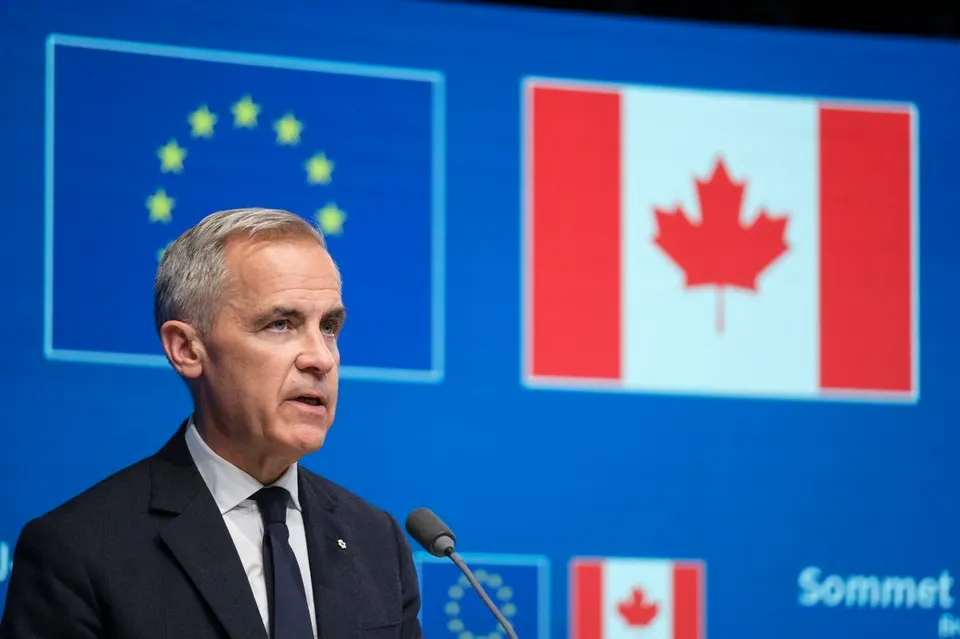
Unfazed by geography, Canadian Prime Minister Mark Carney seems serious about the idea. So does European Commission President Ursula von der Leyen, who broached the topic during her annual State of the Union address on September 16, saying the EU needs to “urgently reimagine our partnerships.” Von der Leyen added that EU and Canada “see the world with the same eyes.” (Ursula von der Leyen, “2026 State of the Union Address,” Sept. 15, 2026.) Whenever a members-only club starts to emphasize shared values, it’s a signal that geographic proximity may matter less than political and cultural affinities.
Canada even recognizes a certain European septuagenarian as its formal head of state (the prime minister is head of government). Technically, Canada is not a federal republic, it’s a constitutional monarchy; legislative enactments must receive royal assent to become statutory law. Six EU member states also have reigning monarchs (Belgium, Denmark, Luxembourg, the Netherlands, Spain, and Sweden). Come to think of it, Canadian accession to the EU would give King Charles III a nontrivial justification for traveling across the English Channel and rubbing elbows with other European royals.
Making The Case
The day after Von der Leyen delivered her remarks, Carney traveled to Strasbourg to pitch the concept of EU accession to the European Parliament. He highlighted the various selling points that make Canada an attractive ally, including its energy resources, critical minerals, and capabilities in space, artificial intelligence, and quantum computing. (Mark Carney, “Address to the European Parliament” (Sept. 17, 2026).) In terms of national wealth and economic production, Canada would undoubtedly be a major addition. It would make up some of the GDP the bloc lost under Brexit. Among the 27 EU member states, only three (France, Germany, and Italy) have a larger nominal economy than Canada. (Pallavi Rao, “How Canada Would Rank in the EU by Five Metrics,” The Visual Capitalist (May 9, 2025).)